2025 -> 2026

January 14, 2026

2025 is a year I’m happy to bid a non-found farewell. I may be the eternal optimist but I have faith 2026 will be a most excellent as Bill and Ted would say year.

2025

Why was 2025 a bad year you ask; I will enlighten you.

I woke one morning and could not see out of my right eye. I was not blind but there was a black spot covering 2/3 of my vision. What I could see out of the remaining 1/3 was severely warped making the eye unusable. I had to close my right eye before I could see correctly out of my left eye. Turns out I have macular degeneration. A regime of shots in the eye has improved my eyesight greatly but the Retina doctor tells the right eye will never be normal.

In 2025 we became very familiar with the Grapevine ER and Hospital. I took Gwen to the ER eight times this year ranging from the catheter blocked, to food stuck in her vocal cords, to could not wake her.

Gwen was hospitalized four times in 2025. The first visit was because they had to operate to remove the food from her vocal chords. Yes, they were being especially cautious as to not damage the vocal cords. The last time because she would not wake up. They finally determined it was because she had a bad reaction to one of her prescriptions even though she had been taking it for three years.

Sandwiched between the other medical events Gwen had a procedure to install a suprapubic catheter in an attempt to stop her malignant UTI. She continues to have them but not as frequently.

That was our 2025. Because of Gwen’s advanced PSP she is homebound and only left home for medical appointments, ER visits, and Hospital stays except for a couple visits to our youngest daughter’s home for family events. I’m out and about to buy groceries, and my medical appointments which are thankfully few and far between except for the Retina Doctor.


2026

I’m determined 2026 will be better.

As for myself, As 2026 rolled in I weighed 230.5, am pre-diabetic, out of shape, and trying to quit drinking wine at night. My intention this year is to live a healthier lifestyle.

For Gwen,We will slow the PSP progression and attempt to keep her out of the ER and Hospital!

Gor ditt basta (Do your best)


2025 Books

December 23, 2025

I’ve been an avid reader my entire life; 2025 was no exception. My favorite genre is Science Fiction. However, I attempt to read at least a dozen non-fiction books every year to expand my horizons so to speak.

This year I read 38 books, 14 of which were non fiction. The non-fiction books (plus two fiction) were:

TItle Author
Right Thing, Right Now Ryan Holiday
Einstein in Kafkaland Ken Krimstein
Meditations Marcus Aurelius
Tiny + Wild Graham Gardner
The Lord of the Rings J. R. R. Tolkhein
Tiny Experiments Anne-Laure Le Cunff
A Brief History of Time Stephen Hawkin
Big Jim and the White Boy David Walker & Marcus Anderson
The Light Eaters Zoe Schlanger
Eat That Frog Brian Tracy
Deliver Me From Nowhere Warren Zanes
Zen Mind, Beginner’s Mind Shunryu Suzuki
Goodbye, things Fumio Sasaki
Blue Mars Kim Stanley Robinson
Wisdom Takes Work Ryan Holiday
The Lord of the Rings J. R. R Tolkhein

Several of the books are re-reads.They belong to the half dozen books I attempt to re-read every few years because I enjoyed them immensely and every time I read them I gain new insights. This year’s were Meditations, A Brief History of Time, and The Lord of the Rings.

I included two fiction books this hear because they are excellent books I’d recommend to everyone:

  • Blue Mars is the third and final book in the Mars trilogy. They are science fiction. The book has a lot to think about concerning life, death, and society.
  • The Lord of the Rings is a fantasy book needing no introduction. I’ve read this really three books over and over since I was young and is one of my all time favorites.

I don’t ever have a favorite book or top five books. However, usually there are several I’d read again and several I would not recommend to anyone.

In addition to the three re-reads mentioned above I’ll put Wisdom Takes Work and Zen Mind, Beginner’s Mind on the shelf and consider reading them again.The former is the last book of the four part Stoic series and I’ve heard the best by far. Time after time I set the book down to just think. The later is a series of talks given by the author during their morning zazen. I don’t follow Zen but this book encouraged me to reflect on life.

Big Jim and the White Boy is not a book worth reading. It’s a graphic novel version of Huckleberry Finn told from the perspective of the slave Jim. Read the original instead.

Before signing off I have to mention Tiny Experiments which is not a book to read over and over again as time rolls on but I started my own Tiny experiments and continue to do so. Might not be a book for everyone but a valuable addition to the lifelong learner’s toolbox.


Trains

November 15, 2025

I was thinking about a friend who is a train aficionado. That got me to thinking about my experiences in trains. Back in the dark ages (1960s) I’d take the Zephyr from Chicago to Galesburg on those weekends I traveled home from college. Two hours from Chicago to Galesburg was much faster than driving. During the winter months the Zephyr was packed with people taking a few days off their normal routines for the ski slopes. The party atmosphere on those evenings filled the train.

A few years later married with three small children we took the Santa Fe from Cleburne (south of Fort Worth) through Kansas City to Galesburg. Those trips were not as enjoyable:

  • The trip was much longer (15 hours as opposed to 2)
  • We rode coach – Gwen’s dad was a Santa Fe brakeman – relatives of employees were free in those days
  • We had three small children
  • The ride was rougher
  • On one Summer trip the A/C broke. That was a killer

I’ve avoided U.S. trains ever since.

CleanShot 2025-11-15 at 12.23.

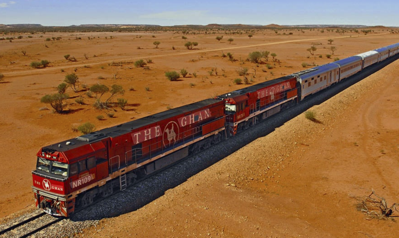
However time rolled on and our excursion from Alice Springs to Adelaide on the Ghan was “Most Excellent” as Bill and Ted would say. We had our own compartment. The service was top flight. The food was world class for Australia. Of course we were leaving “The Alice” after 17 months where fine dining was meat pie floaters – a meat pie filled with meat of unknown origin floating in a bowl of pea soup. Plus, our itinerary included a few days in Adelaide. I love that city. If I could have worked there instead of Alice Springs we would have stayed permanently and I would be typing this memory from my back porch looking out on a grove of eucalyptus trees.

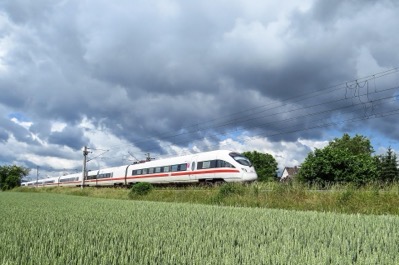
In the later years we rode the rails so to speak in Europe several times. Our experience there was much more enjoyable than our Santa Fe trips. If only train service in the U.S. was half as good as The Ghan or European travel.

Intercity express 1284735_1920.


Fall Plant with color

October 27, 2025

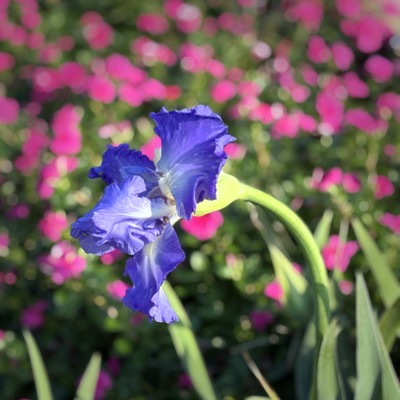
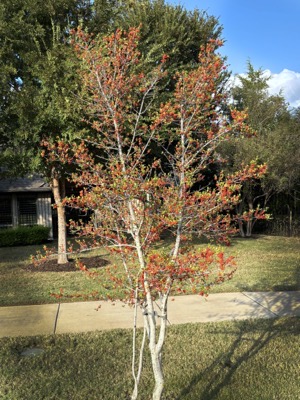
I noticed a couple colorful plants in the green way in back of our home. Took photos with my iPhone 15 because my other camera battery was dead.

Iris 2025 10 26 GreenBelt.
An Iris

Possumhaw Holly 2025 10 26 GreenBelt.
Possumhaw Holley


NotePlan

October 19, 2025

Over the years I’ve used a number of task managers:

  • My Head:Kept everything in my head. Much spilled out
  • Paper: One Program I worked would not allow us to bring anything to work that was not in our pockets. I used pocket notebooks for everything including task management
  • Remember the Milk: Along came the Internet and I discovered RTM. Just found out it’s still there. Wow, after all these years!
  • todo.txt: I started todo.txt after I retired. As the name implies it’s a plain text based system using tags. The standard version had a group of Unix scripts to make task management easier. I added a few of my own in Python.
  • GoodTasks: Layer on top of Apple Reminders and Calendar

And the along came NotePlan which started using earlier this year after a multi-year stay with todo.txt

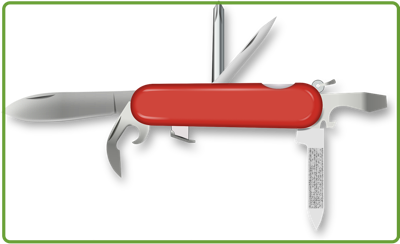
The closest metaphor is the Swiss Army knife.

Swiss army knife 152394_1280.

Why do I use NotePlan? ->

  • Apple based,
  • Markdown,
  • Local storage,
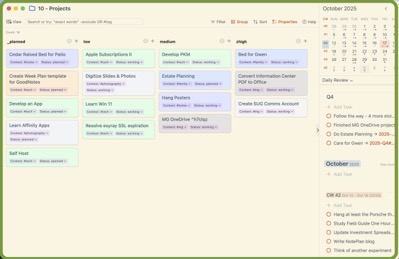
  • Projects,
  • Intuitive interface,
  • Extensible

NotePlan Components

NotePlan’s major components are:

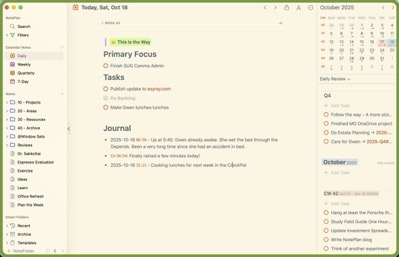
  • Task Management – Features Yearly, Quarterly, Monthly, weekly and Daily tasks. NP supports projects as well. IT also has time blocking, task filters, and recurring tasks
  • Notes – Based on text files using the Markdown format. It also has “wiki” note linking. You can use #tags for topics and @mentions to assign tasks or reference people, which are instantly searchable.
  • Calendar Integration – Integrates with iCloud, Google, and Exchange calendars. The integrated calendar, tasks, and notes display makes planning your day, and projects easy.
  • Knowledge Management – The text files based, markdown format, wiki linking, hast tagging, and mentions enable knowledge management

NotePlan Today 1.


NotePlan Characteristics

  • Plain Text files based on Markdown
  • All data is yours. Unlike some applications NotePlan data is stored on my system – in my case iCloud but other options are available
  • Wiki forward and back note linking
  • Apple Based
  • Cloudkit syncing
  • Tags
  • Mentions – references people and notes – for example: “Finalize plan with @jane-doe”
  • Search
  • Filters
  • Plugins – many already available and you can roll your own
  • Projects
  • Properties – Files can have user definable properties
  • Tasks, Checklists, Actions
  • Note Publication – A very intriguing feature I discovered after using NotePlan for some time is the Publish Notes capability

NotePlan Projects Bordered.


Here’s a couple sources explaining why to use NotePlan better than I can

Why Use NotePlan

My Productivity Workflow


Other App Posts:


My favorite C&W Tunes

September 20, 2025

My favorite C&W tunes

Do thoughts ever pop into your head for no apparent reason? Happens to me from time to time. This morning I wondered for no apparent reason “What is my favorite Country and Western song?” I opened my laptop and started jotting down the first few songs that came to mind. Here’s the result:

  • Amarillo by Morning
  • 16th Avenue
  • Your the Reason God Made Oklahoma
  • The Perfect C&W Song
  • Good Ole Boys Like Me
  • Wagon Wheel
  • I’m so Lonesome I Could Cry
  • He Stopped Loving Her Today
  • I Fall to Pieces
  • Ruby’s two sad daughters
  • Last Date

After thoughts

  • 10 did not do 10 on purpose therefore I added another to make the list the not 10 list
  • I had not thought of a couple of the songs in years. Last Date and I Fall to Pieces
  • They reflect my age as none of them are recent. The oldest is 1949’s I’m So Lonesome I Could Cry. The newest is “Ruby’s Two Sad Daughters” in 2000 by pat Green and the author, Walt Wilkins.

The Grid

August 23, 2025

Rating: 4 of 5 – Type: Science

I grew up on a farm in the northern midwest. At that time power outages were not uncommon. After high school I moved to Chicago where during the great blizzard of 1967 when we were stranded in our apartments and finding bread at a local mom & pop’s corner store was major coup we still had power. Through the years residing and working in a number of areas from the Midwest, to Texas, to Australia we always had power. Now all three of our children work in the Power Industry I’ve become very interested in Power – how it’s produced, how it’s transmitted, and how it’s used.

Therefore I asked Google what are the best books on the Power Grid. The Grid: The Fraying Between Americans and Our Energy Future by Gretchen Bakke was on the top of the list. I bought the Kindle version and used the power from my Kindle’s battery to read it.

The lion’s share of the book narrates the Grid’s history from its humble beginnings starting at Edison’s Pearl Street Station in 1892 to the present day.

Then it transitions into a few of the famous power outages of the past 25 years, what caused the outages, and in some cases the steps taken by the affected customers to insulate themselves from the Grid’s brittleness.

Of course, the book covers Enron and the Grid’s transition to the free market in great detail

The book’s final sections detail the Grid’s current brittleness, the emerging technologies and the problems they cause, the financial crisis, the increasing demand for power the Grid can’t supply, and the trends for the future.

In summary, The Grid chronoicles America’s transition to the “Electrical Age” and the Grid that made it possible.

Notes:

  1. The planet is powered by electricity; the Grid is but the backbone to generate and deliver Electricity. I did not mention electricity once in the book! Amazing or bad writing?
  2. All of my blog posts are now book reviews. I used to write about travel, gardening, and other the like. However, I’m now homebound. My life is taking care of my wife, reading books, watching TV, and the Internet. I find nothing worth writing about on TV or the internet. Writing about politics , the environment, except Silent Spring, and climate change depresses me. Therefore I choose to write book reviews blog posts.
  3. According to Gemini the Grid’s biggest problems 10 years after the book’s publication have not changed:
    • Outdated equipment
    • Increased demand
    • Vulnerability to extreme weather
    • Integrating renewable energy
    • Cybersecurity and Digitalization (This item is new)
    • Lack of investment and modernization

Silent Spring

August 13, 2025

Silent Spring by Rachel Carson ushered in the Environment Era when published in 1962.

Rating: 5 of 5 – Type: Science

In many ways it was the harbinger of the tumultuous 60s. Whereas the 50s were a quiet Leave it to Beaver era the 60s were civil rights, war protest, riots, and society disruption era typified by Four Dead in Ohio.

In the book Rachel describes mankind’s destruction of the natural order though the use of pesticides in the environment. It is equally a science book and a political call to action on the harm we are inflicting on Nature. The modern environmental movement is the direct result of the book. Many believe the political activism of the 60s started with the public outcry her book spawned.

Unlike many books promoting this cause or that cause Rachel’s analysis and conclusions are backed up by a tome of references. The book’s reference section is almost as large as the rest of the book.

On a personal note I turned 16 the year she published her work. I grew up on a Illinois farm. The day she published the book I probably sprayed DDT around our three milk cows to kill flies twice a day in the barn before I milked them. Thankfully my using caustic chemicals on the farm in my younger days did not cause me lasting harm as those same chemicals have done to many.

Summary – It’s a sobering book that everyone should read.


The Light Eaters

July 16, 2025

Rating: 4 of 5
Type: Nature

Way Back Machine

Whoa, If I’m glad I did not read this book 25 years ago. I would have reverted back to my 21 years old “WE ARE DESTROYING THE PLANET” self!

Jumping into the way-back machine in my early years before life had beat me down I was sure we were well on the road to making the planet uninhabitable. In 1946, my birth year, the planet contained 2.3 billion humans. By 1964, the year I graduated from college, the world contained 3.28 billion souls. Using simple math I calculated in the year 2000 the Planet would contain over 7 billion humans. Obviously, to me any others way to many humans for the Plant to sustain. Today, the World’s Population is 8.062 Billion.

Two years prior in 1962 Rachel Carson published Silent Spring which woke up any of us to the harm we were inflicting on our environment.

After high school I became a True Believer. I protested and bored others on how to change their habits to stop the insanity. Then life got in the way! I fell in love, married, graduated from college, started a job, and had children. Other worries took over.

Looking back, the Jackson Browne tune The Pretender fits me to a “T”. The tune’s key phrase We started out so young and strong only to surrender sums everything up.

What does all that have to do with the booK? Read on and find out.

Summary

In The Light Eaters Zoe Schlanger takes us on an exploration of emerging revolutions in Plant Science forcing us to ask questions like:

  • What is a plant
  • Are plants intelligent
  • Are plants sentient
  • Are plants Conscious

In the first couple chapters the author takes us on a journey around the world describing the amazing diversity of plant life and along the way building the portrait of “what is a plant”.

Then she narrates the evolution from when the ancient Greeks considered plants to be alive and deserved respect to now our attitude is plants exist only to serve mankind. By the way, this is the chapter that woke the way back machine driving me to a frenzy about how we treat the planet.

The remaining chapters explore plant characteristics by reviewing scientists performing research and providing examples of the plant characteristics they are studying. Chapter by chapter she attempts to build the case for plant intelligence.

Multiple research studies show plants have many capabilities we “Higher Life Forms” possess:

  • Touch
  • Hearing
  • Memory
  • Communicate with both plants & animals
  • Sight
  • Recognize their kin
  • Cooperate with Fungi to form communities

In the final reckoning it’s high time we changed our attitudes towards plants. AS the author states

Plants eat light. Photosynthesis, so basic to plants, is the prerequisite for most every other life form on earth.

Examples

I included a few examples. If you are interested grab a copy of the book and prepare for a fascinating journey.

Plants have the sense of touch Touch. She provides many examples such as the Mimosa pudica whose leaves suddenly go limp when it is touched. Botanists believe it is to discourage caterpillars from eating the leaves. Moving along, you can change the plant’s growth pattern by touching in repetitively. In the greenhouse you can change the plant’s growth pattern by touching it repeatedly causing it to grow stouter sacrificing height. How does this work? Scientist believe plants have a nervous system but they have been unable to locate it.

Plants communicate with animals. In a study led by Dr. Consuelo De Moraes, researchers found that when a caterpillar begins chewing on a corn plant, the plant releases a chemical gas. This gas attracts a species of wasp that preys on the caterpillar, helping to protect the corn from further damage.

Can plants See? Everyone agrees plants sense light but can plants truly see?. Going beyond sensing light an example is the “Boquila trifoliolata” from South America. It mimics the shape, size, and even color of the leaves of plants it grows near. This mimicry is precise and can copy multiple host plants at once, even artificial ones. The jury is out on why but sight is gaining more traction with the researchers. Other possibilities include microbe transfer or chemical transfer

Multiple researches have proven plants recognize plants of their own kind. For example, Sunflower roots are tightly packed when Sunflowers are grown closely together but when they sense plants of another species they aggressively spread their roots. Susan Dudley believes plants recognize other plants by the color of light and change their behavior accordingly.

AI version

Because I’m curious about AI I asked the AI on my web browser (DIA) for a summary of the book. The AI version is more concise than mine and doesn’t ramble as much. Here’s what the AI returned:

In “The Light Eaters,” Zoë Schlanger explores the hidden world of plant intelligence and what it means for how we understand life on Earth. Schlanger takes readers on a journey through forests and scientific labs, sharing stories about how plants can sense their surroundings, communicate with each other, and even defend themselves from threats. She describes fascinating examples, like tomato plants releasing chemicals to make caterpillars turn on each other, or pitcher plants tricking wasps with fake pheromones.

The book dives into the debate about whether we should call these abilities “intelligence” or “consciousness,” since plants don’t have brains like humans or animals. Schlanger explains that while plants act in complex ways, scientists disagree on whether these actions count as true intelligence or are just the result of natural programming. She also talks about how our language and thinking are so human-centered that we often end up describing plants in ways that aren’t quite accurate.

Overall, “The Light Eaters” mixes science, philosophy, and personal stories to show that plants are not just background scenery but active participants in the ecosystem. The book encourages us to look at plants in a new light and to appreciate the amazing things they can do, even if those things are very different from human intelligence.


What’s Important Now

May 23, 2025

A few days ago I was searching for something worthwhile to watch on YouTube and stumbled across The 5 types of Wealth a book by Sahil Bloom on Google Talks –> 5 types of wealth – Google Talks. The title intrigued me; I watched the episode.

The episode was excellent.

According to Mr. Bloom the 5 types of wealth are:

  • Time
  • Financial
  • Social/family {family added by me}
  • Health
  • Mental

We all have different seasons of life. Depending on the season one is in a different type of wealth outweighs the other seasons.

An example Bloom gave was when he was living in San Francisco and had a very successful career. His parents lived on the east coast. One day a friend asked him how old his parents were. Bloom answered the mid-60s. Then the friend asked him how often her saw them. Once or twice a year Bloom answered. Finally, the friend replied, you will probably see them a dozen more times until they pass on. Bloom thought about that for a while then quit his job and moved his family back to the east coast to be closer to his parents.

If I were younger I’d buy the book but I’m 78 and my wife’s caregiver. Therefore, what’s important to me for the foreseeable future is Time and Social/family. As for the other three Finance, Health, and Mental, at 78 it’s too late to do anything about them.

Too bad I didn’t come across this concept earlier when I was focused money to support my family. I’m sure we could have “gotten by” on less.
For more information on the book and the author: Click Here