I noticed a couple colorful plants in the green way in back of our home. Took photos with my iPhone 15 because my other camera battery was dead.
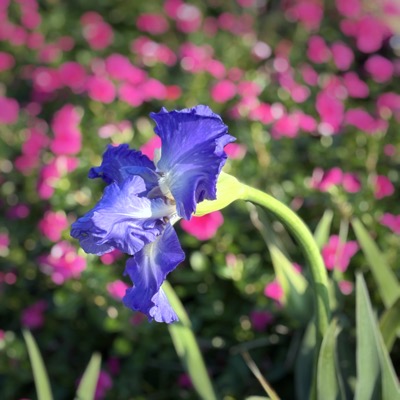
An Iris

Possumhaw Holley
I noticed a couple colorful plants in the green way in back of our home. Took photos with my iPhone 15 because my other camera battery was dead.
An Iris
Possumhaw Holley
 Leave a Comment » |
  Environment, Nature, Plants | Tagged: Flower, holly, iris |
  Permalink
 Posted by molson46
Rating: 4 of 5 – Type: Science
I grew up on a farm in the northern midwest. At that time power outages were not uncommon. After high school I moved to Chicago where during the great blizzard of 1967 when we were stranded in our apartments and finding bread at a local mom & pop’s corner store was major coup we still had power. Through the years residing and working in a number of areas from the Midwest, to Texas, to Australia we always had power. Now all three of our children work in the Power Industry I’ve become very interested in Power – how it’s produced, how it’s transmitted, and how it’s used.
Therefore I asked Google what are the best books on the Power Grid. The Grid: The Fraying Between Americans and Our Energy Future by Gretchen Bakke was on the top of the list. I bought the Kindle version and used the power from my Kindle’s battery to read it.
The lion’s share of the book narrates the Grid’s history from its humble beginnings starting at Edison’s Pearl Street Station in 1892 to the present day.
Then it transitions into a few of the famous power outages of the past 25 years, what caused the outages, and in some cases the steps taken by the affected customers to insulate themselves from the Grid’s brittleness.
Of course, the book covers Enron and the Grid’s transition to the free market in great detail
The book’s final sections detail the Grid’s current brittleness, the emerging technologies and the problems they cause, the financial crisis, the increasing demand for power the Grid can’t supply, and the trends for the future.
In summary, The Grid chronoicles America’s transition to the “Electrical Age” and the Grid that made it possible.
Notes:
Leave a Comment » | Books, Environment, weather | Permalink
Posted by molson46
Silent Spring by Rachel Carson ushered in the Environment Era when published in 1962.
Rating: 5 of 5 – Type: Science
In many ways it was the harbinger of the tumultuous 60s. Whereas the 50s were a quiet Leave it to Beaver era the 60s were civil rights, war protest, riots, and society disruption era typified by Four Dead in Ohio.
In the book Rachel describes mankind’s destruction of the natural order though the use of pesticides in the environment. It is equally a science book and a political call to action on the harm we are inflicting on Nature. The modern environmental movement is the direct result of the book. Many believe the political activism of the 60s started with the public outcry her book spawned.
Unlike many books promoting this cause or that cause Rachel’s analysis and conclusions are backed up by a tome of references. The book’s reference section is almost as large as the rest of the book.
On a personal note I turned 16 the year she published her work. I grew up on a Illinois farm. The day she published the book I probably sprayed DDT around our three milk cows to kill flies twice a day in the barn before I milked them. Thankfully my using caustic chemicals on the farm in my younger days did not cause me lasting harm as those same chemicals have done to many.
Summary – It’s a sobering book that everyone should read.
Leave a Comment » | Books, Environment, Nature | Permalink
Posted by molson46
Rating: 4 of 5
Type: Nature
Whoa, If I’m glad I did not read this book 25 years ago. I would have reverted back to my 21 years old “WE ARE DESTROYING THE PLANET” self!
Jumping into the way-back machine in my early years before life had beat me down I was sure we were well on the road to making the planet uninhabitable. In 1946, my birth year, the planet contained 2.3 billion humans. By 1964, the year I graduated from college, the world contained 3.28 billion souls. Using simple math I calculated in the year 2000 the Planet would contain over 7 billion humans. Obviously, to me any others way to many humans for the Plant to sustain. Today, the World’s Population is 8.062 Billion.
Two years prior in 1962 Rachel Carson published Silent Spring which woke up any of us to the harm we were inflicting on our environment.
After high school I became a True Believer. I protested and bored others on how to change their habits to stop the insanity. Then life got in the way! I fell in love, married, graduated from college, started a job, and had children. Other worries took over.
Looking back, the Jackson Browne tune The Pretender fits me to a “T”. The tune’s key phrase We started out so young and strong only to surrender sums everything up.
What does all that have to do with the booK? Read on and find out.
In The Light Eaters Zoe Schlanger takes us on an exploration of emerging revolutions in Plant Science forcing us to ask questions like:
In the first couple chapters the author takes us on a journey around the world describing the amazing diversity of plant life and along the way building the portrait of “what is a plant”.
Then she narrates the evolution from when the ancient Greeks considered plants to be alive and deserved respect to now our attitude is plants exist only to serve mankind. By the way, this is the chapter that woke the way back machine driving me to a frenzy about how we treat the planet.
The remaining chapters explore plant characteristics by reviewing scientists performing research and providing examples of the plant characteristics they are studying. Chapter by chapter she attempts to build the case for plant intelligence.
Multiple research studies show plants have many capabilities we “Higher Life Forms” possess:
In the final reckoning it’s high time we changed our attitudes towards plants. AS the author states
Plants eat light. Photosynthesis, so basic to plants, is the prerequisite for most every other life form on earth.
I included a few examples. If you are interested grab a copy of the book and prepare for a fascinating journey.
Plants have the sense of touch Touch. She provides many examples such as the Mimosa pudica whose leaves suddenly go limp when it is touched. Botanists believe it is to discourage caterpillars from eating the leaves. Moving along, you can change the plant’s growth pattern by touching in repetitively. In the greenhouse you can change the plant’s growth pattern by touching it repeatedly causing it to grow stouter sacrificing height. How does this work? Scientist believe plants have a nervous system but they have been unable to locate it.
Plants communicate with animals. In a study led by Dr. Consuelo De Moraes, researchers found that when a caterpillar begins chewing on a corn plant, the plant releases a chemical gas. This gas attracts a species of wasp that preys on the caterpillar, helping to protect the corn from further damage.
Can plants See? Everyone agrees plants sense light but can plants truly see?. Going beyond sensing light an example is the “Boquila trifoliolata” from South America. It mimics the shape, size, and even color of the leaves of plants it grows near. This mimicry is precise and can copy multiple host plants at once, even artificial ones. The jury is out on why but sight is gaining more traction with the researchers. Other possibilities include microbe transfer or chemical transfer
Multiple researches have proven plants recognize plants of their own kind. For example, Sunflower roots are tightly packed when Sunflowers are grown closely together but when they sense plants of another species they aggressively spread their roots. Susan Dudley believes plants recognize other plants by the color of light and change their behavior accordingly.
Because I’m curious about AI I asked the AI on my web browser (DIA) for a summary of the book. The AI version is more concise than mine and doesn’t ramble as much. Here’s what the AI returned:
In “The Light Eaters,” Zoë Schlanger explores the hidden world of plant intelligence and what it means for how we understand life on Earth. Schlanger takes readers on a journey through forests and scientific labs, sharing stories about how plants can sense their surroundings, communicate with each other, and even defend themselves from threats. She describes fascinating examples, like tomato plants releasing chemicals to make caterpillars turn on each other, or pitcher plants tricking wasps with fake pheromones.
The book dives into the debate about whether we should call these abilities “intelligence” or “consciousness,” since plants don’t have brains like humans or animals. Schlanger explains that while plants act in complex ways, scientists disagree on whether these actions count as true intelligence or are just the result of natural programming. She also talks about how our language and thinking are so human-centered that we often end up describing plants in ways that aren’t quite accurate.
Overall, “The Light Eaters” mixes science, philosophy, and personal stories to show that plants are not just background scenery but active participants in the ecosystem. The book encourages us to look at plants in a new light and to appreciate the amazing things they can do, even if those things are very different from human intelligence.
Leave a Comment » | Books, Environment, Nature | Tagged: consciousness, intelligence, Plants | Permalink
Posted by molson46
I have never posted a political post but recent events have driven me to do so now. Also, I read that one should document their beliefs on important, to them, subjects.
Donald Trump’s first month in office has shown his True Colors.
Trump is a bad man. Trump does bad things. Why is Trump a bad man? Here’s the reasons from an unknown author that I could not express better myself:
Because he is the embodiment of evil, cruelty, nastiness, rudeness, dishonesty, corruption, selfishness, vanity. Because he is a liar, a thug, a con artist, a misogynist, a narcissist and a sociopath. Because he is completely devoid of humanity, empathy, sincerity, and respect for anything or anyone but money and power. Because he has no boundaries, tact, class, or a moral compass. Because he is profoundly ignorant of history and culture and utterly indifferent to anything that does not directly affect his own ass.
Tariffs: I’m a firm believer the World is Hot, Flat, and Crowded as documented by Thomas Friedman in the book of the same name. From automobiles to semiconductors the development lifecycle is tightly integrated and multinational. The design is performed in one country, the multimillion dollar machines to fab the semiconductor are built in another country, the company ordering the semiconductor is in another country, the raw materials to build the actual semiconductor are in several other countries,the company fabricating the semiconductor are in yet another country, the construction of the product using the semiconductor is in another country, and the products are sold in many other countries. Creating tariffs on every country to country transit on semiconductors could well double and eventually triple the price.
Government’s Size: while I agree with the concept his methods are dehumanizing. Firing or laying off people by email or locking the doors to the office and announcing on X (Twitter) is no way to run a company let alone a government. Many of these people have devoted their careers to public service. Let’s treat them with some dignity.
Environment: The Republican Party denies the climate is changing in spite of overwhelming evidence. It’s not a theory any more; it’s a fact. Trump has not just ignored the environment. He has doubled down on ruining the planet by cancelling the previous administration’s pitiful attempts to save the environment by executive order.
World Politics: Trump and his cronies have alienated the rest of the World except our arch enemy Russia via tariffs and insults. Now those that make any sense?
Immigration: The Trump administration has been really quiet on immigration after a few highly publicized raids. They need to stop ruining the World’s economy with tariffs, f***ing the environment, and eliminating portions of the US government. Instead,fix immigration! I agree with cracking down on the border. The influx of illegals is out of control. The asylum criteria is laughable. The asylum criteria should be a much, much higher bar than it is. His claim that he has reduced immigration by 95% is misleading if not an outright lie. He compared Biden’s 7 years immigration numbers with his first 7 days in office. Thus he compared apples to oranges. Even then the reduction was 60% not 95%.
I could go on and on and on and on but I’ve limited the post to 3,000 word and I’ve already exceeded my self imposed limit. Let’s pray God sends down a little wisdom to him, his co-president Musk, and his other cronies.
1 Comment | Environment, Opinion, Politics | Tagged: Environment, Immigration, Tariff, Trump | Permalink
Posted by molson46
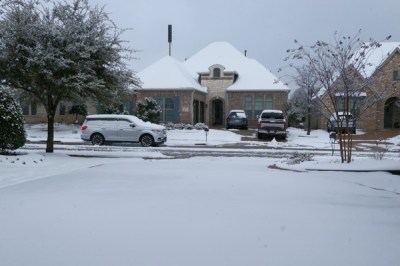
We had, for us, a major winter storm starting yesterday (January 9) and ending today around Noon (January 10). In total we received 4 inches of snow. I took a few photos looking on my front and back doors. I would have loved to take a hike and shoot some photos in nature but am a homebound caregiver for my wife Gwen.
Unfortunately the snow will all have disappeared by tomorrow.
Here in DFW the average snowfall is 1.7“. So, here in Trophy Club we received over 2 average years of snow.. The record year was 17.6” in 1976–1977. Comparing to where I grew up near is 34“ with the 1976–1977 winter having the record at 69.7”. Of course they are used to snow and have the equipment to take handle that much snow unlike here in DFW. But I grew up on a farm in the middle of nowhere, Illinois. No snowplows cleared the road past our farm. We either waited for it to melt or cleared the road ourselves.
Last time I blogged about snow was a long time ago in a county not that far away – Click Here
Here’s a few photos from our home in Trophy Club:


Leave a Comment » | Environment, Family | Tagged: DFW, Snow, Trophy Club | Permalink
Posted by molson46
Woke this morning at 5. Took Gwen to the bathroom. Laid down and then the wind picked up. 75mph in our neighborhood. Lots of rain. No power for 6 hours but feel lucky. Thousands are still in the dark in the DFW area. #event
Leave a Comment » | Environment, weather | Tagged: weather | Permalink
Posted by molson46
Today, September 8, the high temperature in DFW was 109. Overall, this is our third hottest Summer in North Texas since we’ve been recording temperatures in 1898 according to the National Weather Service. I find it interesting the local and national TV newscasts state this is the second hottest Summer on record
I’ve lived in the DFW area through all of the 5 hottest Summer:
Lack of rain also accompanies hot weather here and this Summer was no exception. If you don’t count the .2 inches of rain DFW received, which we did not we’ve gone over 60 days without rain. (The record is 84 days).
The photo below was taken on one of the walking trails in our neighborhood. A typical August/September day in North Texas and everything is brown except for trees.

Although the temperature was 109 today the humidity was 19%. I felt more comfortable outside in the shade today than at Cardinal games in 90 degree, 90% humidity weather.
Leave a Comment » | Environment, Nature, Science, weather | Tagged: weather summer hot | Permalink
Posted by molson46
Hot, Flat, and Crowded by Tomas Friedman (2008): started me pondering upon wicked problems and how to solved them. It been 15 years since I read that book. During that interval I’ve identified a host of wicked problems but have not untangled a single problem.
I’ve been thinking about this post for months. Naming on three problems is an impossible task. I started out by just noting down a list of problems which took me about 10 minutes:
I knocked out Population because it’s so general most of the problems facing us today are children of population. Besides what can we do about the number of people on the planet. We certainly can’t euthanatize 3/4 of the population! If I had to name the ONE problem it would be population.
So, the problem has to be one we can solve.
I crossed out Hackers because they are a nuisance and at least for now don’t affect most of us.
So, the problem has to be one that affects the general population.
Since I live in the USA the problem should be one that greatly affects the USA. For example, the war in the Ukraine is a terrible event but a long way off for me.
To cut the number to three I did a mini-trade study. The criteria were;
It was a tough call between Abortion and Illegal Aliens but in the end Abortion won out. First, it’s been a problem since at least Roe vs. Wade back when Gwen and I were just in love 50+ years ago. Secondly, Its a touchstone between the religious right and the liberals. If they can come to agreement on Abortion then then the lions and the lambs can live together.
And just maybe the Democrats and the Republicans can agree on a few tings
There is no new Water on the Planet unless a large comet strikes which makes the problem mute. Water was a surprise winner for me. The American West is in the middle of a 1,000 year drought. Texas ranchers can’t draw water from the Brazos because Dow Checmial father down stream at Freeport needs it all to create chemicals. They win because the TCEQ says so. Millions maybe billions don’t have clean water to drink. Meanwhile the almond crop in California is sucking the Colorado River dry.
Climate Change affects us all not only the USA but everyone in the planet. However we can’t even agree there is a climate change. Republicans deny it because they believe it will hurt business. Democrats profess to believe the climate is changing but when in office they don’t do anything about it.
i’ll think about this and post an update soon. I don’t like the winners. Just doesn’t seem right for some reason.
In the meantime anyone who can solve one of these problems deserves the Nobel Peace Prize
Leave a Comment » | Environment, Opinion | Permalink
Posted by molson46
#blog #tree #book
A Natural History of North American Trees by Donald Peattle is an unfinished condominium of the trees of North America. I’d recommend it for anyone who loves trees.
This book has a different format than other books about trees I have read. The others typically give the physically characteristics, how to grow it, where it can be grown, know problems, etc. This tree tome, however, in many case documents who discovered the tree, how it is used by the lumber industry, rates its hardness, and even incudes antidotal stories about the tree.
The first edition was published in 1950. It’s gone through several editions since then. The original was published as two volumes which have since been combined into one. Although not stated I believe the author planned to document all the trees in North America but for reasons not documented he did not complete. For example he mentions Live Oaks but did not include a section on that stately tree.
The book book does not have a “plot” or a narrative threading from cover to cover. Rather, each short paragraph documents a different tree species. Therefore the book is probably most useful as a reference to research particular tree species instead of reading cover to cover.
Below are a few examples of items I found interesting in the book:
Leave a Comment » | Books, Environment | Permalink
Posted by molson46
 Number 6's Blog