NotePlan

October 19, 2025

Over the years I’ve used a number of task managers:

  • My Head:Kept everything in my head. Much spilled out
  • Paper: One Program I worked would not allow us to bring anything to work that was not in our pockets. I used pocket notebooks for everything including task management
  • Remember the Milk: Along came the Internet and I discovered RTM. Just found out it’s still there. Wow, after all these years!
  • todo.txt: I started todo.txt after I retired. As the name implies it’s a plain text based system using tags. The standard version had a group of Unix scripts to make task management easier. I added a few of my own in Python.
  • GoodTasks: Layer on top of Apple Reminders and Calendar

And the along came NotePlan which started using earlier this year after a multi-year stay with todo.txt

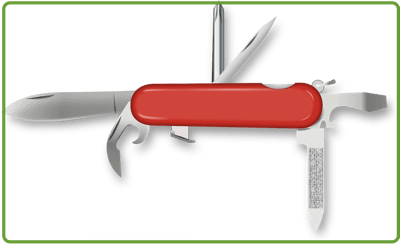
The closest metaphor is the Swiss Army knife.

Swiss army knife 152394_1280.

Why do I use NotePlan? ->

  • Apple based,
  • Markdown,
  • Local storage,
  • Projects,
  • Intuitive interface,
  • Extensible

NotePlan Components

NotePlan’s major components are:

  • Task Management – Features Yearly, Quarterly, Monthly, weekly and Daily tasks. NP supports projects as well. IT also has time blocking, task filters, and recurring tasks
  • Notes – Based on text files using the Markdown format. It also has “wiki” note linking. You can use #tags for topics and @mentions to assign tasks or reference people, which are instantly searchable.
  • Calendar Integration – Integrates with iCloud, Google, and Exchange calendars. The integrated calendar, tasks, and notes display makes planning your day, and projects easy.
  • Knowledge Management – The text files based, markdown format, wiki linking, hast tagging, and mentions enable knowledge management

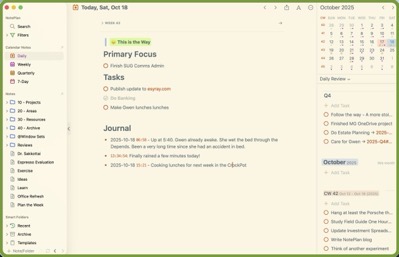
NotePlan Today 1.


NotePlan Characteristics

  • Plain Text files based on Markdown
  • All data is yours. Unlike some applications NotePlan data is stored on my system – in my case iCloud but other options are available
  • Wiki forward and back note linking
  • Apple Based
  • Cloudkit syncing
  • Tags
  • Mentions – references people and notes – for example: “Finalize plan with @jane-doe”
  • Search
  • Filters
  • Plugins – many already available and you can roll your own
  • Projects
  • Properties – Files can have user definable properties
  • Tasks, Checklists, Actions
  • Note Publication – A very intriguing feature I discovered after using NotePlan for some time is the Publish Notes capability

NotePlan Projects Bordered.


Here’s a couple sources explaining why to use NotePlan better than I can

Why Use NotePlan

My Productivity Workflow


Other App Posts:


What’s Important Now

May 23, 2025

A few days ago I was searching for something worthwhile to watch on YouTube and stumbled across The 5 types of Wealth a book by Sahil Bloom on Google Talks –> 5 types of wealth – Google Talks. The title intrigued me; I watched the episode.

The episode was excellent.

According to Mr. Bloom the 5 types of wealth are:

  • Time
  • Financial
  • Social/family {family added by me}
  • Health
  • Mental

We all have different seasons of life. Depending on the season one is in a different type of wealth outweighs the other seasons.

An example Bloom gave was when he was living in San Francisco and had a very successful career. His parents lived on the east coast. One day a friend asked him how old his parents were. Bloom answered the mid-60s. Then the friend asked him how often her saw them. Once or twice a year Bloom answered. Finally, the friend replied, you will probably see them a dozen more times until they pass on. Bloom thought about that for a while then quit his job and moved his family back to the east coast to be closer to his parents.

If I were younger I’d buy the book but I’m 78 and my wife’s caregiver. Therefore, what’s important to me for the foreseeable future is Time and Social/family. As for the other three Finance, Health, and Mental, at 78 it’s too late to do anything about them.

Too bad I didn’t come across this concept earlier when I was focused money to support my family. I’m sure we could have “gotten by” on less.
For more information on the book and the author: Click Here


Tiny Experiments

April 30, 2025

Rating: 5 of 5
**Type: Lifestyle

I read Tiny Experiments on a recommendation from the podcast Bookworm. It is categorized as a Productivity book. However it’s more lifestyle book in my opinion.

The rest of the review are the notes I took while reading the book. Therefore I would have these notes for reference when I want to review the book’s principles.

1. Goal Setting Broken

Linear Goals

Linear goals are not the answer. What’s wrong with them? Here’s a short list:

  • Stimulate Fear – Overwhelm you with choices and to the point where you are unable to take action
  • Encourage Toxic Productivity – Provide a justification for you keep busy. In the end you work long hours and feel guilty for taking breaks
  • Work while sick
  • Breed competition & isolation – Everyone climbing the ladder breeding competition for all the wrong reason. It’s a win-lose scenario

You can’t win the Linear Goal race. Because of social media we compare ourselves to our peers. This is sometimes called the Red Queen Effect. In Through the Looking Glass they all, including Alice, had to run hard to stay in the same place. To go anywhere they had to run twice as hard. Linear goals have the same effect. No matter how many hours you put in the never ending list of linear goals never gets shorter.

Typical responses to linear Goals include:

  • Cynicism – pass up opportunities, make fun of innocent people, …
  • Escapism – retail therapy, binge watching, …
  • Perfectionism – rising early, working long hours, going to bed late, no rest

What do they all have in common? They are all negative. What’s the remedy? Don’t fall for linear progression.

Use a “loop” mental model using iterative cycles of experimentation with each loop building on the last cycle.

Shift from an “outcome” mindset to a “process” mindset.

This is more of a Stoic model where we focus on getting up every day and doing the “”right thing”.

2. Escaping the Tyranny of Purpose

We all have a set of Cognitive Scripts. For example when we visit the doctor we expect to check in, go an examine room, see the doctor, check out, and pickup a prescription.

The act like programmed instructions that we follow in certain situations based on our experience.

These scripts can be bucketed into three categories:

  • Sequel – Do something the same way over and over
  • Crowdpleaser – Follow the crowd and conform to established definitions of success
    > For example we are all pushed to finish school, get a job, meet a partner and start a family whereas you are conforming to a defined path instead of following your curiosity
  • Epic – Follow your passion. Pursue a linear goal focused more on the goal than the journey

Unlearn your script

How do you unlearn your script. Start by asking yourself these questions:

  • Are you following your past or discovering your path
  • Are you following the crowd or discovering your tribe
  • Are you following your passion or discovering your passion

Remember: A little unlearning is a dangerous thing!

The number one barrier to self-renewal is not lack of time or lack of money; it’s not knowing how to begin

One method suggested by author is to record your thoughts for a day. Then take time to read and study them. What am I curious about? What topics make me feel better or worse? For each question develop a hypothesis. These are candidates for your first Tiny Experiments.

Once you have a hypothesis, you can design an experiment and turn your life into a giant laboratory for self-discovery.

3 Create a Pack

After you’ve recorded your thoughts and analyzed them you are ready for the next step –>

The Pact: I will[action] for [duration]

You commit to an action for a set period.

Example: I will exercise every weekday for 4 weeks

A pack is

  • Purposeful
  • Actionable
  • Continuous
  • Trackable

A pack is not

  • Habit
  • New Year’s Eve Resolution
  • Performance Metric
  • Resource Intensive Project

How do you choose your pact? Choose based on your curiosity. What excites you? What do you want to learn?

Here I must admit my first couple experiments were based not on curiosity but on habits I wanted to start and habits I wanted to break. I’m in the middle and don’t know if this will work but I’m hopeful.

4. A Deeper Sense of Time

We will not live forever. We all have around 4100 weeks.Our lives are governed by our calendars and todo lists. But it doesn’t have to be that way.

The ancient Greeks had the concept of different types of time:

  • Chronos -Quantity – How we normal think of time – the blind march of time
  • Kairos -Quality – not all time is the same. We all have good productive days and not productive days.

    Put another way, with Chronos all time is equal while in Mario’s all time is not equal and the value of time depends on the situation.

To live in Kairos time, we need to shift the focus from what we do with our time to how we experience each moment – what you might call mindful productivity. Time is the most critical resource in traditional productivity. On the other hand, mindful productivity is centered around managing your physical, cognitive, and emotional resources.

Physical Resources

  • Align tasks with natural rhythms
  • Daily cycles matter
  • Sleep matters
  • Energy levels are different at different times of the day / week / month /seasons
  • Respect your natural rhythms

Cognitive Resources

  • Avoid multitasking
  • -Once you have identified your *magic windows” what belongs there

Emotional Resources

  • Adapt stress response – pay attention to your emotions and adapt
  • Stress builds upon stress. Not all stress is bad stress but it’s additive and will at some point turn into distress
  • Movement decreases stress, especially movement in nature

How can you get into the magic window to focus on one task and do your best? Kairos Rituals* are a method to reset your focus.

The Kairos Ritual is small act to open magic window for something you want to direct all your resources towards. Everyone is different but some examples are:

  • mediation
  • walking
  • cup of tea
  • Listen to a favorite piece of music

5. Procrastination is not the enemy

When it comes to productivity, procrastination is public enemy No. 1.

The Buddha says procrastination has two arrows:

  • No. 1 – procrastination itself
  • No. 2 – your emotional reaction to it – anxiety, same, and feeling bad

Procrastination is not doing what you think you should be doing. When you are procrastinating, ask yourself whether it’s coming from the head, the heart, or the hand:

  • Head – Is this task appropriate? If no then redefine the strategy
  • Heart – Is the task exciting – Fear, boredom, or irritation? If no redesign the experience.
  • Hand – Is the task doable? If no then request support or get training

6. Intentional Imperfection

Intentional Imperfection means being deliberate about where you invest your efforts, recognizing that you cannot be at the top all the time and across all areas of life. It’s about striving for sustainable excellence rather than fleeting perfection

At any given moment ask yourself: What is important right now? In which domain do I strategically chose short-term mediocrity to enable long-term excellence?

To practice Intentional Imperfection you must:

  • Identify perfectionist patterns -Become aware of where you are striving for unrealistic perfection
  • Challenge your unrealistic targets – How long will it take to achieve all these goals?
  • Choose progress over perfection – Determine where to achieve excellence and where to lower the bar

7. Creating Growth Loops

Trial and Error coupled with self-reflection are a time tested process to growth.

An excellent method of self-reflection is Metacognition which is usually defined as “thinking about thinking”. What does that mean? My understanding is when evaluating a trial and error cycle we use the results and including our thoughts, emotions, and beliefs to formulate the next trial instead of trying something different. \
Note - the term is very popular in educational settings especillay in England where the author resides

+, -, —> (Plus, Minus, Next)

A way to review the – Week, Month, 0r …

Plus: Write any accomplishments that made you proud, moments that brought you joy

Minus: ID challenges or obstacles you faced. Are there tasks you intended to complete but did not? Did you stray from healthy habits?

Next: Use your insights from both the Plus and the Minus to shape you actions for the upcoming period

+, -, —> works because it’s

  • Fast: takes a few minutes
  • Flexible: works for all areas of your life
  • Future-focused: Don’t dwell on the past – use lessons learned for the future

Mistakes are good: You don’t improve if you don’t make mistakes. Don’t be afraid to make them. Reflect on them and refine your approach for attempts in the future

8. The Secret to Better Decisions

The pact is complete. What comes next? The alternatives are:

  • Persist
  • Pause
  • Pivot

Persist: Taking a Stand – persist on the current pact but extend the time.

Pause: Take a Break – Quit for a period which could be but doesn’t have to be forever. This is not an admission of failure. It’s an exercise in adaptability.

Pivot: Taking. Turn – It’s sometime advantageous to ask yourself if you should adjust parameters of the experiment. Are you curious but you need to make changes to complete the pact? Remember, the primary goal is to learn, grow, and discover more about the world.

9. How to Dance With Disruptions

Disruptions are painful and test our mettle.

Eastern religions teach a form of “letting do”. For example, Taoism which means acting in harmony with the flow of life. Hindu philosophy teaches to practice detachment allowing tranquility with the “Flow of life”.

Or Don’t resist chaos, but embrace it.

Embracing the chaos is a two step process:

  1. Processing the subjective experience – it helps to write your emotions
  2. Managing the Objective Consequences – confront the practical implications

10. How to Unlock Social Flow

As part of the experiments you should join or create a community to share your experiment. By joining a community:

  1. You access a collective set of knowledge greater than your own
    2.The community may reveal additional impacts
  2. Communities can help when you have new or difficult situations

11. Learning in Public

You need to share your experiments in the public arena in for:

  1. Early feedback – Learn faster and connect with people
  2. Increased creativity – more likely to connect the dots between your ideas and other people’s ideas
  3. Clarity – Instead of rushing through the experiment with little thought you will put effort into your strategy and execution

How to share your learning journey in public:

  • Public Pledge – Choose and inform your public about your experiment
  • Public Platform – Choose the appropriate platform. The platform could range from Twitter, to blogs, to podcasts, to YouTube, to …
  • Public Practice – Run the experiment and document what you’ve learned along the way

12. Life Beyond Legacy

The desire for legacy is the desire for evidence that your life, in the end, held meaning. The problem is your are dead then.

Instead focus on generatively which emphasizes using your personal growth to positively impact the world around you.

Focus on the present moment and ask yourself: How can I use my skills and experiences to positively impact the people around me right now?

John Keats:

Life is fleeting and sometimes filled with darkness, the beauty to be found offers a perpetual source of wonder to those who seek it.

Do the Work First

Be proactive and do the work – play and experiment without worrying about milestones – focus on having fun and learning.

Grow lateral Roots

Expand you knowledge across disciplines by focusing in serial on new areas you discover while experimenting

Prioritize Impact Over Image

Allow you life to evolve with your curiosity opening yourself up to new ways of creating value for others

Close the Loop to Open Doors

Finish what your start and reflect on the lessons learned

Play Along the Way

Find joy in what you are doing. We played all the time when we were young and along the way we learned. When did we stop and there is no reason can’t start playing aging.

Stop the experiment if you are not having fun

Conclusion

Principles:

  • Forget the finish line – enjoy the journey
  • Unlearn your scripts – Be curious and break the bonds we have learned since childhood
  • Turn doubts into experiments -when in doubt, run a personal experiment
  • Let go go the chronometer – shift your focus from Chronos to Kairos ( Quantitative to Quality)
  • Make friends with procrastination- Its a signal something is amiss mismatch between your emotional needs, rational aspirations, emotional needs, and practical skills
  • Embrace imperfection – you cannot be excellent at everything in parallel
  • Design growth loops – Do, reflect, and repeat
  • Broaden the decision frame – persist, pause, or pivot
  • Dance with disruption – when life throws you a curveball, stop, and explore the experience before staring to confronting the disruption
  • Seek fellow explorers – be an active participant in communities
  • Learn in public – share the journey as it unfolded both the successes and the failures
  • Let go of your legacy – You will be dead when it happens and you won’t care

Remember:

  • Pact: Commit to Curiosity
  • Act: Practice Mindful Productivity
  • React: Collaborate with Uncertainty
  • Impact: Grow with the World

2024 Book Review

December 26, 2024

Over the years

I’ve always been a book reader since I was a young lad. I started reading probably more out of boredom than. For any other reason. I was maybe 4 or 5 when I burnt my leg in a trash fire on the farm. For months I was confined to laying on the sofa. Today I would have been watching TV the entire convalescent period but this was before TV; therefore I read books and listened to the radio.

I’m an eclectic reader. I’ve read everything from History to Gardening to Science Fiction to Productivity to Computer Science.

Now to what I read in 2024

2024

Looking back at this year I read a mixed bag including fantasy, productivity, and history – 28 books in all. I read a mix of physical and digital books this year although most were digital on a Kindle. Near the end of the year I started listening to books. For those of you who like lists I’ve included the list of the 2024 books at the end of this post.

My favorite book this year was a mixture of science and history: American Prometheus: The Triumph and Tragedy of J. Robert Oppenheimer by Kai Bird and Martin Sherwin. The book served as inspiration for Christopher Nolan’s 2023 biographical film Oppenheimer, starring Cillian Murphy as the theoretical physicist. (Wikipedia). I did not see the movie but hearing about it sparked my interest in the book.

I had wanted to read 12 non-fiction books this year which I did as a form of self-improvement and in the spirit of the mantra “Live as if you were to die tomorrow. Learn as if you were to live forever.” – Mahatma Gandhi.

I also read the last part of the Wheel of Time book series – 9 of the 14 book series. I started the series in mid-2023. I’m the caregiver for my wife who has PSP and therefore am mostly homebound. Therefore there are great portions of the day where I can either read, watch TV, play games, or spend time on the computer. It’s a Fantasy series where the journey is the best part, not the goal. I was underwhelmed by the ending. Would I read the 11,898 page series again – Yes!

Lastly, I tried audio books this year. My take away to date is don’t listen to books you need to pay attention to. At least for me my mind wanders sometimes. That’s not a problem if I’m reading a physical book. But not with an audio book. I find my self hitting the 30 second rewind button a few times. Will I continue to listen to audio books? I believe so but not books like Nexus, one of the couple books I listened to instead of reading. AS an aside the reason I chose that book was the title. In my chosen profession the word was often overused and used incorrectly. I will leave it as an exercise for the reader to google the meaning of Nexus. This book’s author used the word in a more correct manner than it’s often used.

Next year (2025)

I intend to read a mixture of pleasure (Science Fiction and Mysteries) and self improvement books – Learn Forever. I don’t have a set number of books in the self improvement category but here’s my draft list which will change as time goes on:

I already have 5 physical books on the list:

  1. GEB – Reread every year. I am going to read it every year at least until I understand it.
  2. Lord of the Rings – Reread -Fantasy but the book in that genre by which all others are measured
  3. The Light Eaters by Zoe Schlanger – Plant Kingdome
  4. Einstein in Kafkaland by Ken Krimstein – Graphic novel – branching out to graphic novels this year – A year in Prague when Einstein became Einstein and Kafka became Kafka
  5. Big Jim and the White Boy by Marcus Kwame Anderson, David F. Walker – Graphic novel – The retelling of The Adventures of Huckleberry Finn

    Other Candidate books

  • The Ministry of Time by Kaliane Bradley – Science Fiction — Sounds like a winner — something different
  • The Comfort Crisis by Michael Easter — Cal Newport interview. Sounds very interesting
  • The Burning Earth by Sunil Amrith — A New Yorker best book –how we destroyed nature (my words)
  • Every Valley by Charles King– Handel’s messiah and the troubled times that caused it
  • The Cottage Garden by Claus Dalby – lots of photos of cottage gardens
  • Calypso by Oliver K Languid – Space opera I think
  • Slow Productivity by Cal Newport – as the name implies
  • A Brief History of Time by Stephen Hawking – like GEB I continue to read this book until I understand it. However, I think I’m closer to an understanding than with GEB
  • The Sabbath (FSG Classics) by Abraham Joshua Heschel – an old book a the name implies

Books read in 2024:

  • Lord of Chaos by Robert Jordon – One of the Wheel of Time series
  • Six Easy Pieces by Richard Feynman – Six easy science concepts written for the layman by Nobel Prize winner and one of the Atomic Bomb creators along with Robert Oppenheimer
  • Discipline is Destiny by Ryan Holiday – Book on one of the from Stoic Principles – Discipline
  • *A Crown of Sword * by Robert Jordan
  • Winter Storm by Robert Jordan
  • The Path of Daggers by Robert Jordan
  • Budapest by Victor Sebestyen – History of Budapest by a native
  • The History of Almost Everything by Bill Bryson – Not as good as I thought – would not recommend
  • Where Good Ideas Come From by Steve Johnson – took a 10 page explanation and turned it into a boring book
  • Tao te Ching by Stephen Mitchell – central to Taoism
  • American Prometheus by Kai Bird – Book of the year for me
  • The Gathering Storm by Robert Jordan
  • Killing Moon by Jo Nesbo – Norwegian Thriller – the latest in the series of Detective Harry Hole
  • Towers of Midnight by Robert Jordan
  • Lords of Uncreation by Adiran Tchaikovsky – Space Opera – very good – last book in the three book series
  • Knife of Dreams Robert Jordan
  • A World Lit Only By Fire by William Manchester – coming out of the dark ages – section on Martin Luther is the best I’ve read on him
  • Eight Bears by Gloria Dickie – Eight bear species in the World
  • The Bhagavad Gita by Eknath Easwaran – One of the tenets of Hinduism
  • Overboard by Sara Paretsky – Latest book in female Chicago detective series – loved the series in part because it’s based in Chicago where I lived for three years
  • Meditations by Marcus Aurelius – the high lord of stoicism
  • Memory of Light by Robert Jordan
  • New Spring by Robert Jordan
  • The Obstacle is the Way by Ryan Holiday – Productivity book about overcoming obstacles
  • In a Sunburned Country by Bill Bryson – traveling around Australia – good book
  • To Overthrow the World: The Rise and Fall and Rise of Communism by Sean McMeekin – mostly summary of all his previous books. Read them instead
  • Braiding Sweetgrass by Robin Wall Kimmerer – Came in 2nd as my book of the year – combination Indian lore, environmentalism, nature book
  • On Basilisk Station by David Weber – Space Opera – the kind of Science Fiction I enjoy
  • Nexus by Yuval Noah Harari – Could have been subtitled the History of Information – Audio book

Social Media Fast Results

March 2, 2023

Two weeks ago I started a social media fast. Except for email the fast was successful in that I did not use any of the social media apps. See my previous post of click here

Of course I had lots of help from external sources. Gwen broke her kneecap on January 27 and I’m her sole caregiver. This, I have little free time to browse social media apps. Plus:

  • Elon is forcing me to use the Twitter app by shutting down third party interfaces. I tried the Twitter app and I don’t like it. In the past
  • Living without Tumblr is not hard since I rarely opened it either. 
  • I only opened Facebook late at night during tv commercials. Thus giving up Facebook was easy.
  • Instagram was the hardest for me to give up. I generally opened it every morning to view the latest photos and post photos of my own. I am not sure if I will start using it again.  
  • Mastadon is a fairly new social media site for me. I had just created an account and started using it when I decided to try the fast. I will probably experiment with it for art least the near term.

Email was a failure for me. I had decided to only check email three times a day but my friends, family, and Master Gardener cohorts would message me and ask why I had not responded to an email. I finally gave and started checking it periodically. Perhaps I should have included messages in my social fast.

What’s next?

  • Digital news including the Economist. Instead maybe the Dallas Morning News
  • Games on my phone. They serve the same purpose as social media apps for me. If I have a few minutes or just don’t feel like doing anything I play a game. Instead I could just think

Check back in a couple weeks to find out how I’m progressing on this journey.


Resuming my blog

October 20, 2022

Howdy, Several years ago – 2017 to be exact – I paused posting to WordPress and started my own domain’s blog to gain creating website experience. I gave up my website several months ago because my provider (Machighway) was bought out by another company. After numerous problems with their service I gave up the website.

For now I am posting to WordPress again. Sometime in the future I will re-start my website but until then I will utilize this service.

I may publish the last five years on this facility. I have not decided yet. If I can figure out an easy way to do so I’ll press forward with the plan.